
Published on
EV Battery Boom Supports Graphite Market Growth

In the last several years, electric vehicles have become increasingly popular, and many manufacturers are beginning to provide EV options for their consumers. Because of this rise, the demand for graphite has significantly increased. Graphite not only makes up the largest portion of EV batteries, but the most important part of the battery, the anode. The anode is responsible for providing the electric charge that makes the battery work.

The surge in demand for EV batteries has put enormous pressure on mining companies and refineries that source and purify graphite. For the US, keeping up with the demand poses quite a challenge, as the commercial production of refined graphite within the States is very limited. Not long ago, production wasn’t occurring at all in the US, and the country relied heavily on China and others for both natural and synthetic graphite. Today, new tax incentives are driving EV battery makers to source their graphite closer to home. With the shift to a more local approach, companies are itching to find other ways to increase their supply of the material, like utilizing recycled graphite.
Since graphite is lower in value than other materials found within a battery, it was once treated as a byproduct during recycling. Now, battery recyclers are continuously searching for the best method of extracting graphite for recycling. This can be tricky, as some traditional methods of extraction (like smelting and chemical treatment) could either burn off the graphite or damage the crystalline structure. If the recycled graphite is low in purity due to the extraction and cannot meet battery-grade level, then it is useless to the battery industry. Currently, hydrometallurgical and direct recycling approaches have yielded the best results and promise to help lower the cost and environmental impact of obtaining graphite.
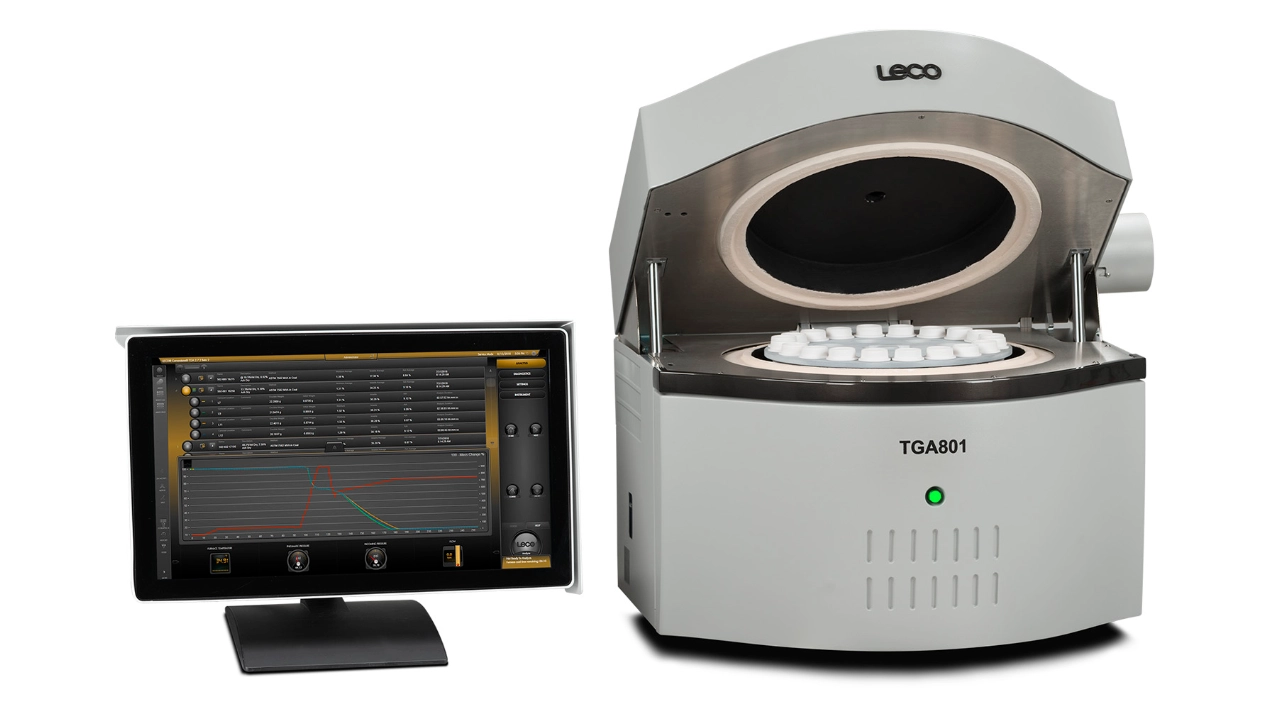
The final step in the process to get this recycled graphite into the hands of buyers is to provide material samples to battery companies so that they can evaluate the material and determine if it is indeed battery-grade. This is the type of analysis that the TGA801 was built for. Using thermogravimetric analysis, the TGA801 can determine moisture and ash content in order to assess the purity of the graphite. The lower the ash content, the purer the graphite is.
Analyze graphite samples with TGA801

Determination of Moisture and Ash in Carbon-Based Battery Materials
Monitoring moisture and ash in graphite and carbon-based battery materials is essential for maximizing Lithium-ion battery performance and safety. The LECO TGA801 uses thermogravimetric analysis to measure mass changes, providing precise data for quality control and material optimization.
203-821-716


 English
 Spanish
 German
 French
 Portuguese